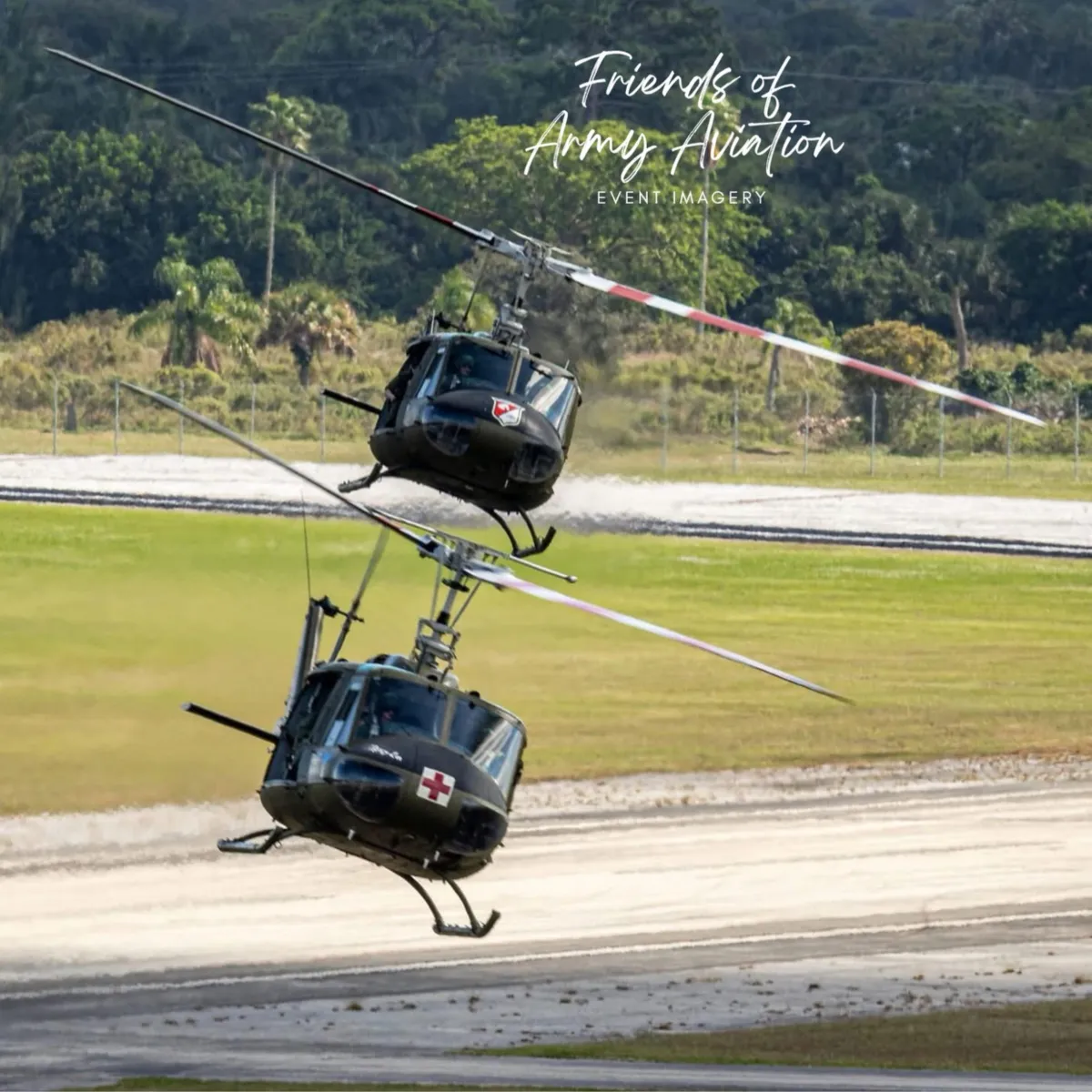
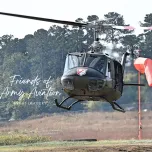
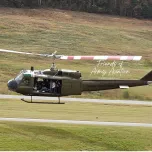
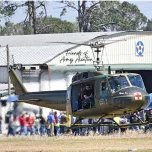
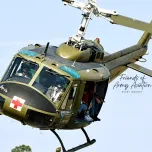
The UH-1H Huey is a single-engine utility helicopter developed by Bell Helicopter and widely used by the U.S. Army beginning in the 1960s. Officially designated the Bell UH-1 Iroquois, it quickly became known as the “Huey,” a nickname derived from its original designation HU-1 (Helicopter, Utility). Even after the designation changed to UH-1, the name Huey remained and became one of the most recognizable in aviation history. Known for its distinctive two-bladed rotor sound and rugged reliability, the UH-1H became the backbone of Army Aviation during the Vietnam War and an enduring symbol of that era.
The aircraft is powered by a L13 turboshaft engine that drives a two-bladed main rotor and tail rotor system. The UH-1H typically cruises between 110 and 120 miles per hour and has a range of roughly 300 miles, depending on payload and mission requirements. Its skid landing gear and relatively simple mechanical design allow it to operate from rough terrain and remote landing zones, making it highly effective in austere environments.
During the Vietnam War, the Huey transformed battlefield mobility. It enabled rapid troop insertion into combat zones, quick resupply of isolated units, and lifesaving medical evacuation missions from the front lines. Armed variants also provided close air support using mounted machine guns and rocket systems.
Although technically capable of single-pilot operation, the UH-1H is commonly flown with a two-pilot crew, often accompanied by a crew chief and door gunner. Its spacious cabin can carry up to 11 combat troops, medical litters for evacuation missions, or cargo and supplies, making it one of the most versatile helicopters ever fielded.
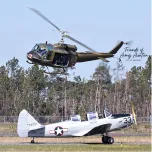
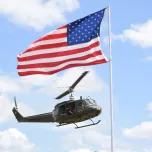
Today, many UH-1H helicopters continue to fly in civilian and historic aviation roles. Preserved by museums, veteran organizations, and aviation groups, the Huey remains a living tribute to the crews who flew them and the soldiers whose lives depended on them.